
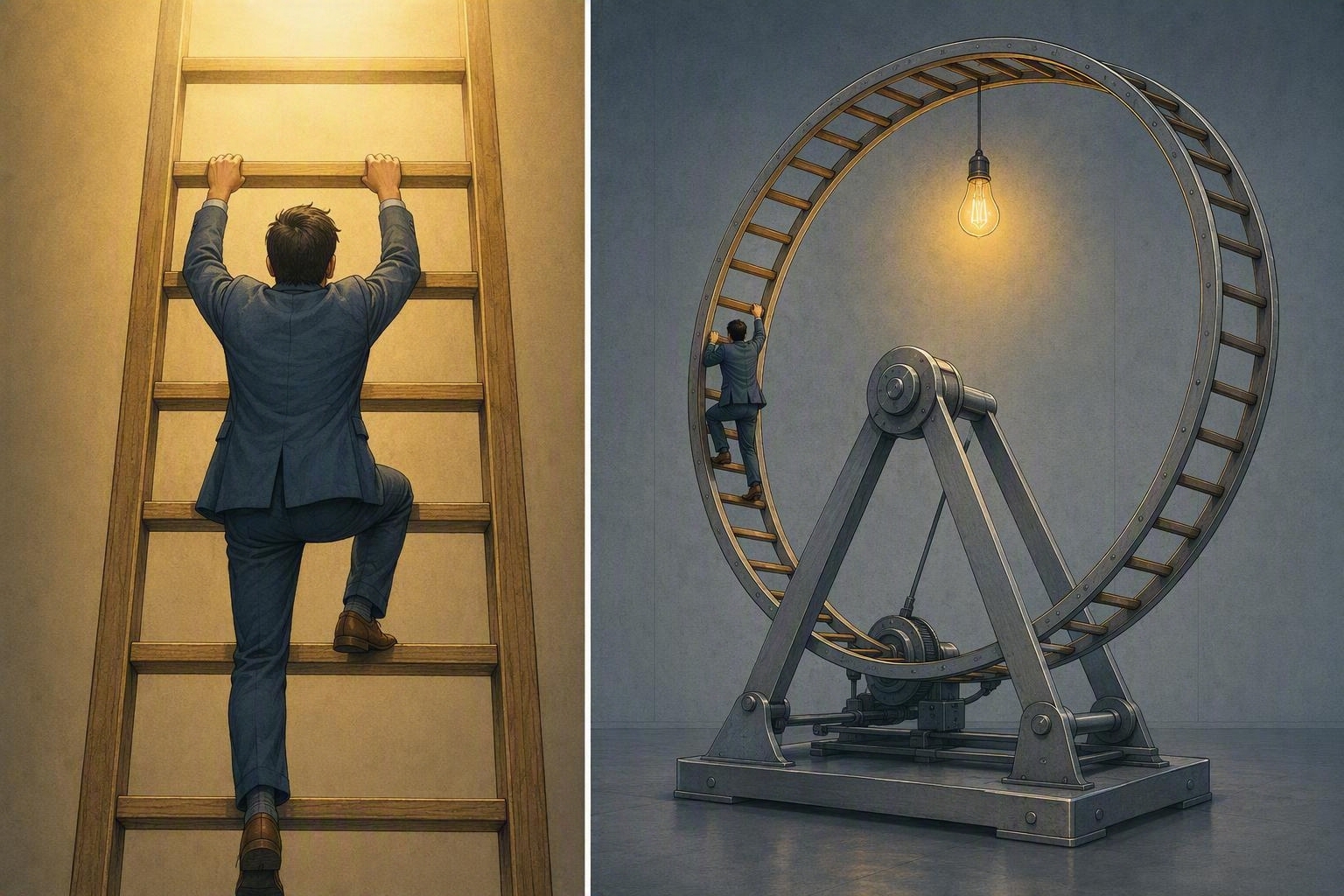
Picture two versions of the same person. In the first, hands on the rung above, one foot pushing off the rung below, golden light spilling down from somewhere unseen and clearly worth reaching. In the second, the camera has pulled back far enough to show the ladder was bent into a wheel a while ago. Same grip. Same posture. Nothing about the motion changed — only that “up” quietly stopped meaning anything, and the light turned out to be an ordinary bulb hung just out of reach, doing exactly what it was installed to do: keep the climbing going.
You cannot tell which one you’re in from the inside.1 That’s not a design flaw. It’s the entire mechanism. Climbing and turning a wheel feel identical to the person doing them.
Nobody sets out to build a wheel. Every wave starts as a ladder for somebody — genuine capability, a real destination. Cloud computing did this for the organisations that actually changed how they architected things. But cloud is also finished enough now to be honest about who was climbing and who was just keeping the wheel turning: certifications, conference badges, migration roadmaps that never quite finished. All real effort. Translation: motion, not altitude.
Mobile had the same shape a decade earlier. Web 2.0 before that. AI is running the identical pattern now, faster, which makes the wheel harder to spot and easier to justify — the volume of genuinely new capability arriving each quarter is real, nobody’s disputing that. What’s less examined is whether reading about it, prompting it, demoing it internally, moves anything at all, or whether it’s just this cycle’s version of the wheel. You can point to the hours. You can point to the changelog you’ve internalised. Neither one tells you whether anything got built.
Society has developed a real fondness for the climbing motion itself lately — the hustle, the staying-on-top-of-it, the seventeen tabs open at once. And that fondness does a lot of work to keep the ladder and the wheel indistinguishable, because a wheel that looks enough like a ladder gets celebrated exactly like one.
I have a personal data point here, and it isn’t flattering. Back in the mobile wave I was fully in the wheel — deep in the running, convinced the running was the point. A former CIO of mine was on a panel at the time, and someone in the audience asked him how he kept the organisation from getting swept up in every cycle of technological panic. I remember bracing for it, half-mortified on his behalf, certain he was about to say something dated and embarrass all of us in front of the room. He didn’t. What he said, roughly, was that a small number of people who actually know what they’re doing, working inside a structure that doesn’t collapse under pressure, will outlast almost any wave you can name. Everything else is the wheel, painted gold.
It landed as a genuine revelation, not a good line I nodded along to. Someone standing outside my particular wheel had just described its exact shape back to me, from a position I hadn’t occupied in months. I respected him a great deal more after that. It’s the closest I’ve come to a real eureka moment about my own habits: you cannot see the wheel you’re in from inside it. You need someone who isn’t running to point at it.
I’m old enough now to hand out cheap wisdom of my own on a panel someday — presumably to a room full of people deep in some wheel I can no longer see the shape of either. That’s roughly how the gold gets repainted.
Et voilà.
If you have to ask which one you’re on, that’s usually the answer — a ladder doesn’t need you to ask. ↩︎